Roofing Job Management Software That Pays Off
A missed call at 8:12 a.m. can turn into a lost $18,000 roof replacement by lunch. That is how thin the margin for error gets when your office is buried in paper estimates, your crews are texting updates from the field, and nobody has a clean view of what is scheduled, sold, completed, and paid. Roofing job management software matters because roofing companies do not lose momentum in one big dramatic failure. They lose it in dozens of small handoff problems every single day.
For a roofing contractor trying to grow, the issue is rarely just "software." The real issue is control. Can you book faster, inspect faster, estimate faster, dispatch faster, invoice faster, and collect faster without adding headcount every time revenue goes up? If the answer is no, the business starts to feel busy without actually becoming more profitable.
What roofing job management software should actually fix
A lot of platforms promise organization. That is not enough. Roofing is not a generic field service workflow with a different logo on it. You are managing inspections, storm response, supplements, material coordination, photo documentation, insurance-related communication, change orders, and crews that need clear information before they climb a ladder.
Good roofing job management software should remove friction across the full job cycle. When a lead comes in, your team should be able to capture the customer, assign the visit, and build an estimate without retyping the same information three times. Once the job is sold, operations should be able to schedule labor, track progress, document issues, and trigger invoicing without chasing updates through calls and text threads.
That sounds obvious, but many roofers are still operating across five or six disconnected tools. One app for scheduling, another for estimates, another for payments, another for CRM, and then spreadsheets filling the gaps. That stack looks manageable at first. It gets expensive and slow once your job volume increases.
The real cost of disconnected roofing workflows
Most contractors underestimate what disconnected systems are costing them because the losses are spread out. One office admin spends 20 minutes rebuilding job data from a call sheet into an estimate. A project manager drives back out to a property because photos were incomplete. An invoice sits unsent for four days because nobody knew the final work was done. A customer calls for an update and the office cannot answer confidently.
None of those problems seem catastrophic alone. Together, they drag down job throughput, technician utilization, and cash flow.
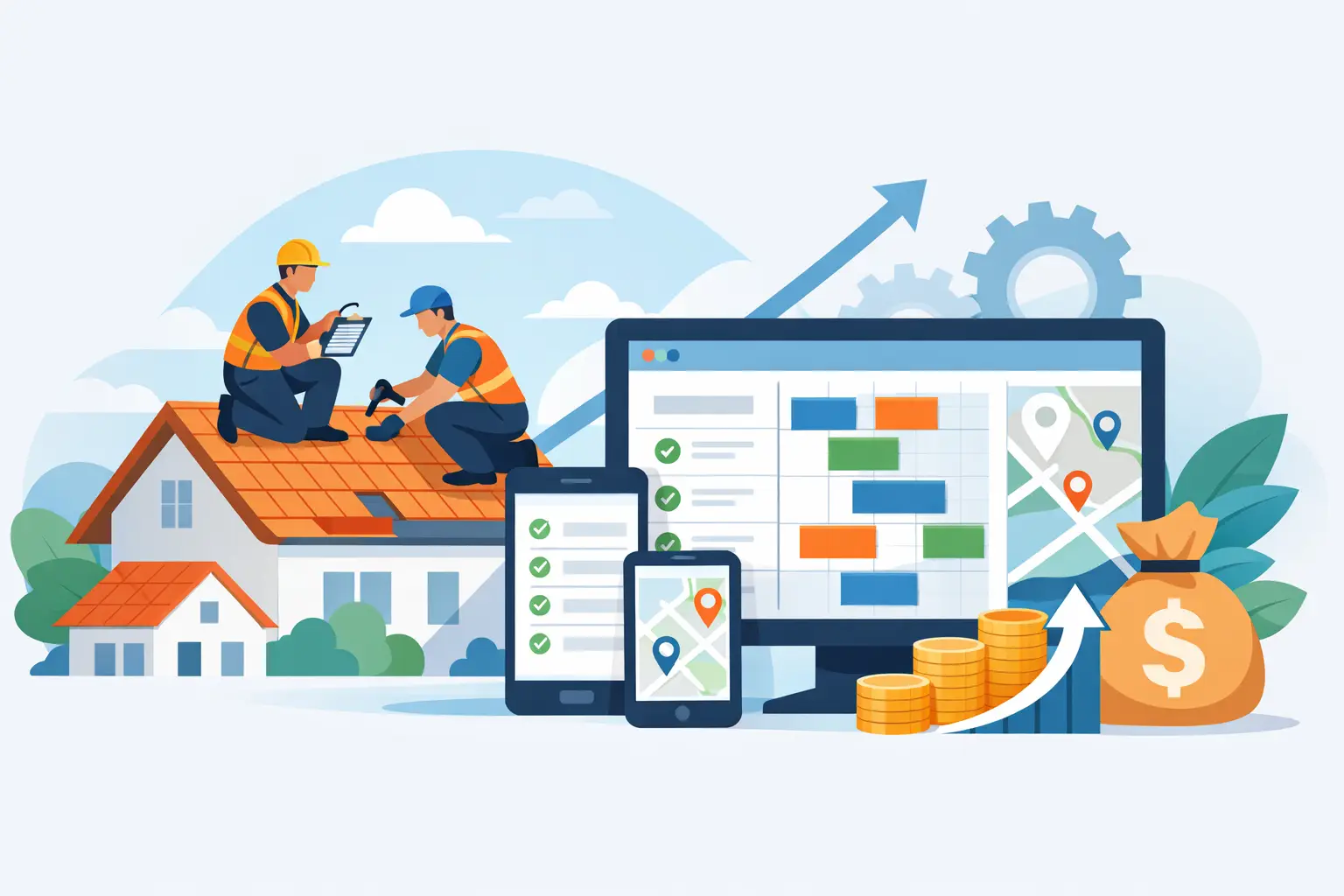
This is where the right platform changes the math. If your scheduling, dispatching, CRM, estimates, invoices, payments, and field workflows all live in one system, every team is operating from the same job record. The office sees what the field sees. The field gets what it needs without waiting on the office. Customers get faster answers. You get fewer bottlenecks between signed contract and collected payment.
Roofing job management software is not just for admin efficiency
The common pitch is that software saves office time. True, but that undersells the upside.
For roofing companies, software should improve revenue quality. Faster estimate turnaround helps you close before competitors do. Better scheduling reduces dead time between inspection, approval, and production. Real-time job status lowers the chance of forgotten supplements, missed follow-ups, or delayed billing. Mobile documentation protects margins when disputes come up. Payment tools shorten the gap between work completed and cash in the bank.
That is why the best buyers are not asking, "Will this help us stay organized?" They are asking, "Will this help us run more jobs per coordinator, per salesperson, and per crew without quality slipping?"
That is a better question.
What to look for in roofing job management software
First, scheduling and dispatch need to work for the pace of roofing operations. You need a visual calendar, drag-and-drop updates, and clear crew assignment, but also the ability to react when weather changes, jobs run long, or materials get delayed. If rescheduling takes too many clicks or creates confusion in the field, your software becomes part of the problem.
Second, estimating has to be fast. Roofers do not have time to build every quote from scratch. The system should help standardize pricing, build proposals quickly, and convert approved work into scheduled jobs without duplicate entry. If you are using voice notes, photos, or field observations to scope work, those inputs should move directly into the estimating process.
Third, mobile field workflows are non-negotiable. Crews and project managers should be able to access job details, upload photos, log notes, track time, and mark progress from the field. If your field team has to wait until they are back in the truck or back at the office to update records, data quality drops fast.
Fourth, payments and invoicing should be built in, not bolted on. A lot of contractors accept delayed cash collection as normal because their systems make billing an afterthought. It should not be. Once work is complete, your team should be able to generate the invoice and collect quickly through the same platform.
Finally, reporting matters. Not vanity dashboards. Actual visibility into job costing, close rates, outstanding invoices, crew productivity, and where jobs are getting stuck. If your software cannot show you where profit is leaking, it is only handling paperwork.
Where AI makes a real difference for roofers
There is plenty of AI hype in software right now, and contractors have every reason to be skeptical. If AI is just a label slapped on top of basic features, it is noise.
But used properly, AI can remove real operational drag from a roofing business. Voice-to-estimate workflows can reduce the lag between field observations and quote creation. AI dispatching can help route work more efficiently when schedules change. AI call handling can prevent missed opportunities when the office is busy or after hours. AI quote suggestions can help standardize upsells or scope options that your team might otherwise leave out.
The important distinction is whether those tools are embedded into daily operations or sold as expensive extras. Roofers do not need more technology to manage. They need fewer manual steps between lead intake, estimate creation, scheduling, job completion, and payment.
That is one reason platforms like ServiceMerge are gaining traction with growth-minded contractors. The value is not just that AI exists. It is that AI is built into the workflow contractors already run, instead of living off to the side as another add-on to buy, learn, and maintain.
It depends on your business model
Not every roofing company needs the exact same setup. A company focused on retail residential replacements may prioritize lead management, fast estimates, financing coordination, and customer communication. A storm restoration operation may care more about rapid intake, documentation, supplements, and handling high job volume with tight office staffing. A commercial roofer may need stronger project tracking, multi-stage approvals, and more detailed cost controls.
That is why choosing roofing job management software is less about feature count and more about workflow fit. More features do not automatically mean better performance. If the system slows adoption or forces your team into workarounds, it will not stick.
The best software feels like it was built for how your office and field teams already operate, then improves that process without adding friction. Fast implementation matters. Mobile adoption matters. Ease of use matters. A platform can be powerful and still fail if crews refuse to use it or the office spends weeks trying to configure basic workflows.
The smartest buying question to ask
Do not ask vendors whether they support roofing. Everyone says yes.
Ask how many steps it takes to go from inbound lead to scheduled inspection, from inspection to estimate, from signed job to dispatched crew, and from completed work to collected payment. Ask what is included in the base system versus what requires another paid module. Ask what your dispatcher, estimator, and field lead will actually do differently on day one.
That is where the truth comes out.
If a platform reduces handoffs, centralizes job data, improves crew visibility, and speeds up payment, it is not just software overhead. It is operational leverage. And in roofing, leverage is what lets you grow without hiring your way around broken processes.
The roof does not care how many apps your team is juggling. The customer definitely does not. They care whether you show up prepared, communicate clearly, finish the job, and invoice without drama. The right system helps you do that at scale, which is exactly why this decision deserves more attention than another spreadsheet ever will.
Ready to run a smarter field service business?
Dispatch jobs, send invoices, collect payments, and track your techs in the field — with AI-powered scheduling, route optimization, and tools that cut admin work so your team stays on jobs, not paperwork. Built for many trades like plumbing, HVAC, roofing, and electrical — view the full list of trades.