AI Receptionist Software Review for Contractors
A missed call at 4:47 p.m. can cost more than the last job on your board. In field service, phones do not just ring - they create revenue, schedule pressure, after-hours emergencies, and customer expectations all at once. That is why any serious ai receptionist software review has to start with one question: does the system actually help your shop book more work without creating more cleanup for the office later?
For contractors, that is the line that matters. A flashy voice bot is useless if it fumbles a plumbing emergency, books the wrong service window, or sends bad information to dispatch. The best AI receptionist software does not just answer calls. It captures intent, qualifies the lead, routes urgency correctly, and pushes clean job data into the rest of your operation.
What an AI receptionist software review should really measure
Most software reviews get distracted by surface-level features. They focus on whether the assistant sounds natural, whether it offers custom greetings, or whether it can handle basic FAQs. Those things matter, but they are not what decides ROI for a service business.
For a contractor, the real test is operational. Can the system answer every call during peak volume? Can it tell the difference between a new install lead and a no-cooling emergency? Can it collect service address, problem details, and contact information accurately enough that your CSR or dispatcher does not have to call back and re-do the intake?
That is where weak tools get exposed. Some AI receptionist platforms are built for generic small businesses like salons, law offices, or med spas. Those products may be fine at appointment booking, but field service is different. Your calls are messier. Customers describe problems poorly. Urgency changes by trade. And one bad intake can wreck route efficiency for the whole day.
The biggest strengths of AI receptionist software
When the product is good, the upside is real. First, it closes the gap between office hours and actual demand. Customers call when equipment fails, pipes burst, drains back up, or power issues turn urgent. If your team cannot answer, AI can cover overflow, nights, weekends, and lunch-hour spikes without the payroll cost of staffing every gap.
Second, it reduces admin drag. A capable AI receptionist can handle repetitive call types like reschedules, business hours, service-area questions, financing basics, and first-pass lead capture. That frees your office team to work higher-value tasks like dispatch coordination, estimate follow-up, and payment collection.
Third, it creates a more consistent front-end process. Human CSRs vary. Some are great closers. Some miss details. Some are overwhelmed when the phones stack up. AI, at its best, follows the same intake path every time and makes fewer avoidable mistakes.
There is also a speed advantage. If the receptionist software connects directly to scheduling, customer records, and dispatch workflows, the handoff gets much tighter. That matters because every extra manual step slows response time and increases the chance of bad data.
Where AI receptionist tools still fall short
This is where a fair AI receptionist software review needs some honesty. AI is not magic, and not every call should be fully automated.
Trade-specific nuance is still the biggest challenge. A customer saying, "My AC is running but not cooling," sounds simple, but that one sentence could signal several issue types with different urgency, technician requirements, and likely ticket values. A generic AI model may capture the words without understanding the service context.
Accent handling, background noise, emotional callers, and multi-part explanations can also trip up weaker systems. If your customer is standing in a flooded basement or outside next to a loud condenser unit, speech recognition quality matters a lot more than the demo video suggests.
There is also a trust issue. Some customers are fine talking to AI. Others want a person, especially for high-ticket jobs or stressful service calls. That means the best setups usually include a smart escalation path, not pure automation. If the platform cannot transfer seamlessly to a live team member or flag sensitive calls for human follow-up, you risk frustrating the customer instead of helping them.
AI receptionist software review criteria for field service businesses
If you are comparing options, look past the sales pitch and pressure-test the workflow. Start with call handling quality. You want accurate transcription, natural responses, and the ability to gather the details your team actually needs. That includes address, callback number, service type, urgency, and problem description.
Next, check trade fit. Can the system be tailored for HVAC, plumbing, electrical, roofing, or drain calls? Generic scripts are a problem. A contractor-focused AI should understand the difference between maintenance, install leads, emergency service, warranty calls, and existing-customer issues.
Integration is where the serious separation happens. If the AI receptionist lives in its own silo, your office still ends up doing manual entry. That kills a lot of the labor savings. The better approach is software that connects intake directly to CRM, scheduling, dispatch, and estimating so the call turns into action without double work.
You should also test after-hours logic. Does the software know which calls become emergency dispatches, which can wait until morning, and which should be converted into scheduled appointments? Not every missed call deserves a truck roll, and not every urgent caller should sit in a voicemail queue.
Finally, look hard at pricing structure. A lot of vendors sell the base tool cheaply, then charge extra for integrations, custom workflows, analytics, or higher call volume. Contractors should pay attention to what is included by default versus what becomes an add-on once adoption grows.
Why standalone tools often create a second bottleneck
A standalone AI answering service can solve the first problem - missed calls - while creating a second one downstream. If the bot captures leads but your team still has to retype notes, verify details, assign jobs, and rebuild estimates from scratch, the efficiency gains shrink fast.
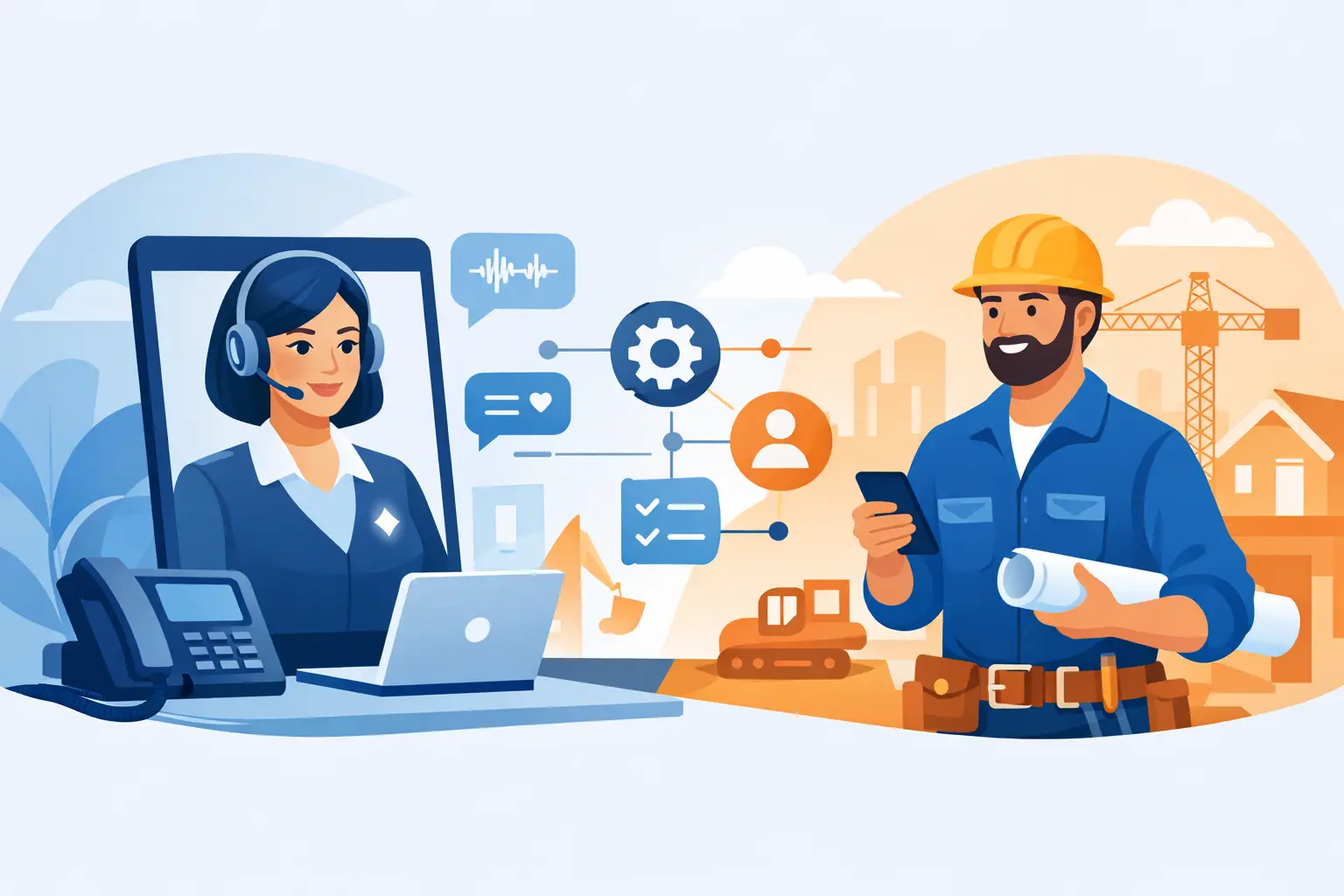
That is why more contractors are looking at embedded AI instead of isolated AI. When the receptionist is tied into the same system that runs scheduling, dispatching, customer history, invoicing, and technician workflows, the data actually compounds. A call is not just answered. It becomes a job record, a route decision, a quote opportunity, and eventually a payment event.
That integrated model tends to outperform point solutions because the value is not limited to phone coverage. It improves the full job cycle, from first contact to closed invoice.
Who should buy now, and who should wait
If your business misses calls regularly, runs lean in the office, or struggles with after-hours coverage, now is a good time to evaluate AI receptionist software. The same goes for shops with growing ad spend. If you are paying to make the phone ring, you need better capture when the board gets busy.
If your call volume is low and your owner still answers most calls personally, the urgency may be lower. In that case, AI can still help, but the return may not be immediate unless it is part of a larger platform upgrade.
Larger teams with multiple CSRs also need to think carefully about implementation. AI works best when you define call flows, escalation rules, service categories, and handoff standards up front. If your office process is loose, automation can expose that fast.
The verdict from a contractor’s point of view
A useful ai receptionist software review should not ask whether AI sounds impressive. It should ask whether it helps your company book more jobs, reduce office strain, and move cleaner information into dispatch.
For field service, the best products are not the ones with the fanciest voice demo. They are the ones that understand contractor workflows, handle messy real-world calls, and connect directly to operations. That is the difference between a novelty tool and something that actually protects margin.
If you are shopping this category, prioritize trade-specific logic, strong intake accuracy, and deep workflow integration. One example of that direction is ServiceMerge, where AI is built into the broader operating system instead of sold as a disconnected extra. That model makes more sense for contractors because the call is only the start of the job.
The right AI receptionist should make your business faster, not just sound modern. If it cannot help your office book cleaner work and keep the field moving, it is not really solving the problem you have.
The smartest move is to test any option against your busiest day, not the vendor’s best demo. That is where the real answer shows up.
Ready to run a smarter field service business?
Dispatch jobs, send invoices, collect payments, and track your techs in the field — with AI-powered scheduling, route optimization, and tools that cut admin work so your team stays on jobs, not paperwork. Built for many trades like plumbing, HVAC, roofing, and electrical — view the full list of trades.