AI Dispatching vs Manual Scheduling
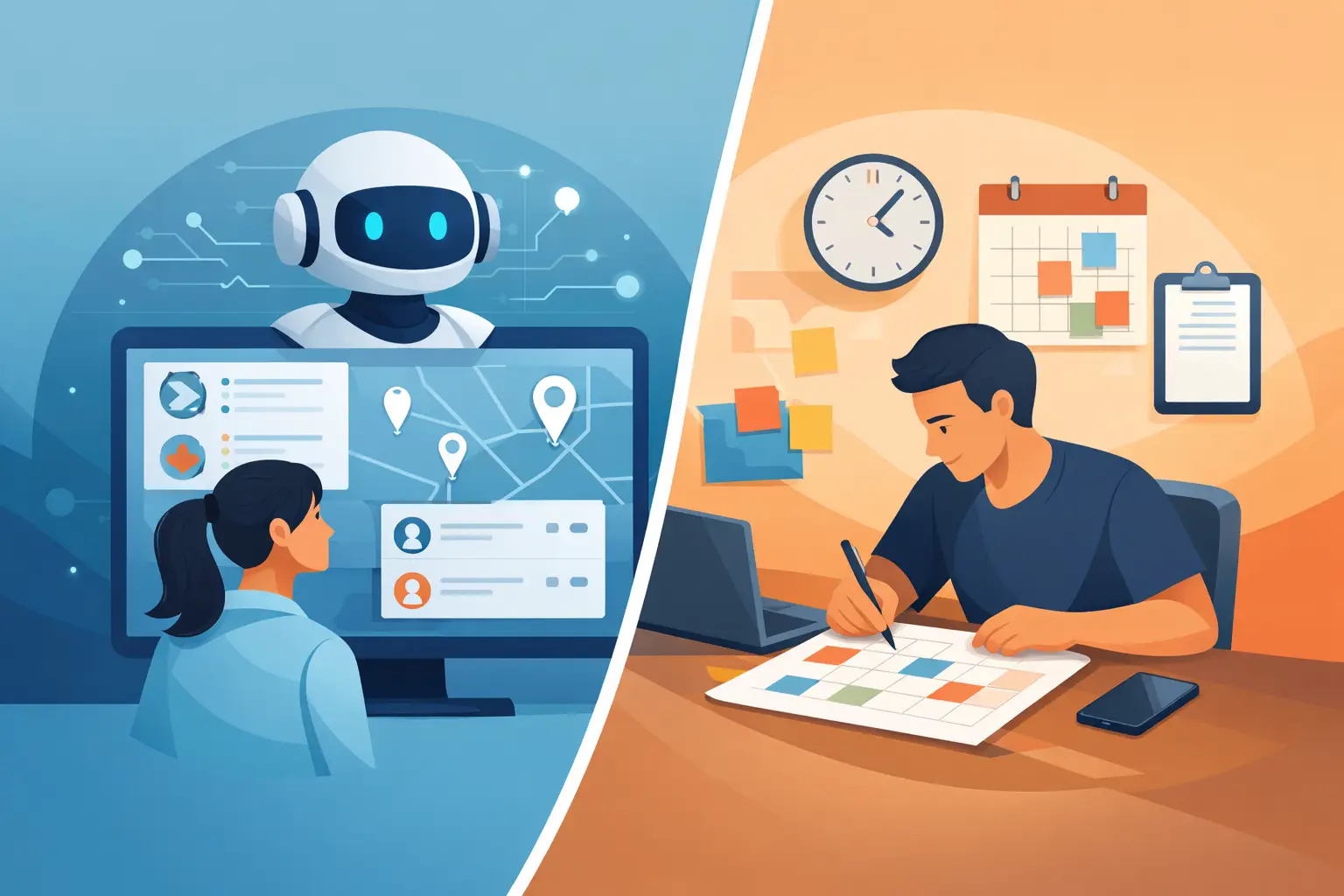
At 4:37 p.m., the board changes again. A tech is running late, one customer wants an earlier arrival, another job just turned into a bigger repair, and dispatch is trying to squeeze in one last call before the day closes. That is where ai dispatching vs manual scheduling stops being a software debate and becomes a profit decision.
For field service companies, scheduling is not just admin work. It drives truck utilization, payroll efficiency, customer satisfaction, and how many jobs your team can actually complete in a day. The old way can still work when volume is low and one experienced dispatcher has everything in their head. But once call volume rises, service areas expand, and more technicians hit the road, manual scheduling starts leaking margin in places most owners do not see right away.
AI dispatching vs manual scheduling in the real world
Manual scheduling depends on people making dozens of fast decisions with incomplete information. A dispatcher checks the board, looks at technician availability, tries to remember who is strongest on a certain job type, estimates drive time, and then reacts to whatever changes next. Good dispatchers can do this well. Great dispatchers can do it under pressure. The problem is that the whole system depends on speed, memory, and consistency from a few key people.
AI dispatching handles the same decision set differently. Instead of relying on memory and manual board updates, it evaluates technician skills, open capacity, job priority, geography, traffic assumptions, and schedule changes in real time. It can suggest the best technician for a call, tighten route efficiency, and rebalance the day as conditions change. That does not eliminate human oversight. It removes the low-value guesswork that slows everything down.
This matters because dispatching is rarely broken in one dramatic way. It is usually death by small losses. Five extra minutes between jobs. A top tech sent across town for a routine service call. A dispatcher spending twenty minutes moving appointments around after a cancellation. One missed same-day opportunity because the board looked full when it really was not.
Where manual scheduling still holds up
Manual scheduling is not automatically wrong. For smaller shops with low job volume, a tight service area, and a very experienced office team, it can still be enough. If you have three technicians, mostly repeat work, and predictable demand, the cost of changing systems may feel bigger than the cost of staying manual.
There is also a flexibility argument. Skilled dispatchers know customer history, technician personalities, and local quirks that software may not fully understand on day one. They know which tech can calm down an upset homeowner, who sells well on replacement calls, and who should not get the attic crawlspace job at the end of a ten-hour shift.
That human judgment matters. But it matters most when it is applied to exceptions, not every routine decision. If your best dispatcher is spending the day dragging jobs around a board, calling techs for updates, and manually calculating who should take the next job, you are using expensive talent on mechanical work.
Why AI dispatching changes the economics
The strongest case for AI is not that it looks modern. It is that it changes capacity without adding headcount.
A dispatch team using AI can process more jobs with fewer slowdowns because the system is constantly evaluating the schedule. It can surface the next-best appointment slot, match work orders to technician skill sets, and reduce windshield time without someone manually checking a map every few minutes. Over a week, that can mean more completed calls, tighter arrival windows, and less overtime.
It also reduces the key-person risk that hurts growing service businesses. If one dispatcher holds the operation together through tribal knowledge, you do not really have a scalable system. You have a bottleneck. AI helps standardize decision-making so the business performs more consistently, even when staffing changes or call volume spikes.
For owners, the real win is margin protection. Better dispatching can increase revenue by fitting in more jobs, but it also cuts hidden costs. Fewer unnecessary miles. Less idle technician time. Fewer scheduling mistakes that trigger callbacks, customer frustration, or overtime pay. Those are not flashy savings, but they show up fast.
The trade-offs nobody should ignore
AI is not magic, and contractors should be skeptical of any vendor that sells it like a silver bullet. AI dispatching is only as useful as the data and workflow behind it. If job types are inconsistent, technician skills are not mapped correctly, and your team is still managing work across scattered apps and phone calls, results will be limited.
There is also a change-management issue. Some dispatchers hear AI and assume replacement. That is the wrong frame. The better frame is leverage. AI should make a strong dispatcher faster, more accurate, and less buried in repetitive work. It should free them up to handle exceptions, VIP accounts, escalation calls, and customer communication that actually needs human judgment.
Then there is the operational maturity question. A company with frequent last-minute changes, emergency service, and a wide service area usually benefits quickly from AI. A very small company with stable demand may not see dramatic gains immediately. That does not mean AI is a bad fit. It means the value curve depends on complexity and volume.
AI dispatching vs manual scheduling for growing contractors
Growth is where manual scheduling usually starts to break.
The first sign is not always chaos. Often it looks like decent revenue with a stressed office team. Dispatchers stay late. Technicians complain about routing. Customers get broad arrival windows because nobody wants to overpromise. Same-day opportunities get missed because the board is too hard to optimize in real time.
The second sign is inconsistency. Your best dispatcher can run a good day. Your average dispatcher cannot. One office handles schedule changes better than another. One branch gets strong technician utilization while another has too much downtime. That inconsistency becomes expensive as you add trucks.
AI gives growing contractors a system that scales with complexity. Instead of adding more admin labor every time volume increases, you improve the speed and quality of scheduling decisions across the board. That is how you grow without letting overhead eat the gains.
This is also where an all-in-one platform matters. If dispatching sits in one tool, customer history in another, invoices somewhere else, and technician updates come through texts and calls, AI cannot perform at its best. The cleaner the workflow, the stronger the dispatching logic. That is why built-in AI is more useful than bolt-on features that live outside daily operations.
What to measure before you choose
If you are deciding between keeping manual scheduling and moving to AI, look at operating metrics, not opinions. Start with average jobs completed per tech per day, drive time between calls, overtime hours, first-time fix support, and same-day booking rates. Then look at office workload. How much time does dispatch spend building schedules, adjusting routes, handling delays, and communicating updates?
If your technicians are productive, your office team is not overloaded, and your service area is simple, manual scheduling may still be enough for now. If you are seeing routing waste, slow reaction to schedule changes, or admin strain as volume rises, manual processes are probably capping growth.
The best operators also look at customer impact. Tight dispatching improves ETA accuracy and response times. Customers may not care whether a board was managed by a person or AI. They care that someone shows up when promised and gets the job done fast.
The smarter model is not AI alone
The strongest dispatch operation is usually not fully manual or fully hands-off. It is AI-assisted with human control.
Let the system handle optimization, recommendations, route logic, and schedule reshuffling at speed. Let your dispatch team handle exceptions, service priorities, relationship-sensitive accounts, and the real-world judgment that software cannot always replicate. That is the model that gives contractors both efficiency and control.
For field service businesses serious about growth, ai dispatching vs manual scheduling is really a question of how long you want critical decisions trapped in spreadsheets, whiteboards, and individual memory. Teams that want more jobs per truck, less office drag, and tighter margins are moving toward AI for a reason. Platforms like ServiceMerge are pushing that shift further by baking AI directly into the operational workflow instead of charging extra for disconnected tools.
If your schedule still depends on who is in the office and how fast they can react, you do not just have a process. You have a ceiling. The right time to fix it is before the next busy season proves it for you.
Ready to run a smarter field service business?
Dispatch jobs, send invoices, collect payments, and track your techs in the field — with AI-powered scheduling, route optimization, and tools that cut admin work so your team stays on jobs, not paperwork. Built for many trades like plumbing, HVAC, roofing, and electrical — view the full list of trades.